NPS comment analysis means reading the text answers under the 0 to 10 question and grouping what repeats. Do it by score group: (1) split detractors (0 to 6), passives (7 and 8) and promoters (9 and 10), (2) group each pile's reasons in their own words, (3) count against the group, (4) name nothing under ten comments.
Why one pile of comments misleads you
Read every NPS comment in one list and two things go wrong. First, the same topic means opposite things at different scores. "Sync" from someone who gave a 3 is a complaint; from someone who gave a 10 it may be the reason they stay. Lumped together, the two become one topic called "sync", and you can't tell whether to fix it or advertise it.
Second, the groups are rarely the same size, so a count across all comments hides who said it. Twelve mentions of slow sync out of sixty comments looks modest. If all twelve came from the twenty-three detractors, it is about half of them.
Passives lose the most. In a mixed list their mild comments sit between the angry ones and the glowing ones, and they get skimmed, though an 8 is one point away from a promoter.
The method, step by step
1. Split by score before you read
Sort the export by the score column and cut it into three: 0 to 6, 7 and 8, 9 and 10. Drop rows with a score but no comment; there is nothing in them to group. Keep the date column, you will want it later.
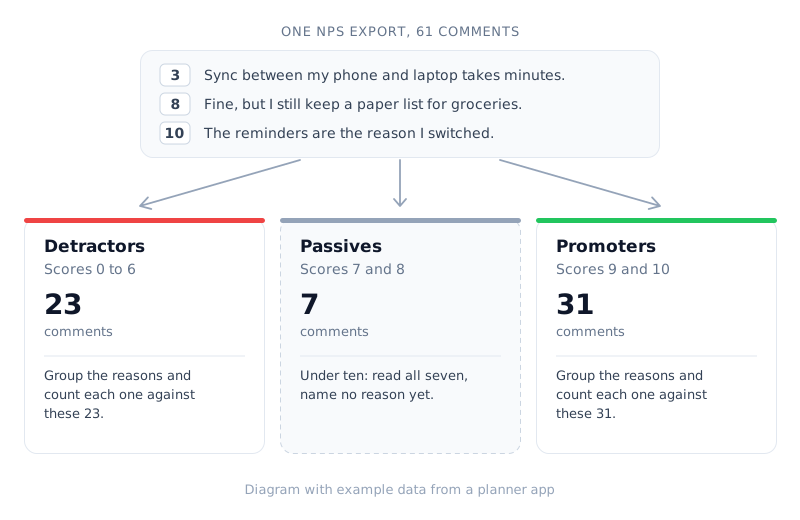
Diagram with example data.
2. Group each pile on its own
Read the detractors first, then the promoters, then the passives. Write each reason in the words people used: "a task added on the laptop takes minutes to show up on the phone" is a reason, "performance" is your team's label for it. A comment can hold two reasons, and then it counts under both.
3. Count against the group, not the survey
A reason's share is its comments divided by the comments in its own group. Nine of twenty-three detractors is a different finding from nine of sixty-one people. When you report it, say which group it came from, so nobody reads a detractor reason as a verdict on everyone.
4. Set a floor before you name anything
A group with seven comments is seven people. Any reason you name from it rests on two or three of them, and it will look exactly as solid on a slide as a reason backed by forty. Below ten comments, read the group and quote it, but don't turn it into a list of reasons. Why ten, and what counts as one response, is in how many survey responses you need for insights.
5. Keep two or three comments under every reason
Copy them word for word. They settle what a reason means when someone disagrees with your summary, and a team will read them when it skips your summary. The same habit applies to any open-ended survey analysis.
Doing it in RawQuotes
RawQuotes is not an NPS tool. It doesn't read the score, work out the NPS or split anything by it, so step 1 happens in your spreadsheet: filter the score column and save three files.
Upload each file into its own project. When you import a spreadsheet, you mark which column holds the comment and which holds the date, and the score column stays out. Insights are counted per project, across every source in it, so one project per group gives each group its own insights and its own count.
In Insights, switch to Month and pick the month of the survey. If that month ended before you uploaded the file, it first shows how many responses it hasn't counted yet; recompute it by hand (Basic or Pro). Each insight then shows its share of that group's responses and opens into the comments it was counted from.
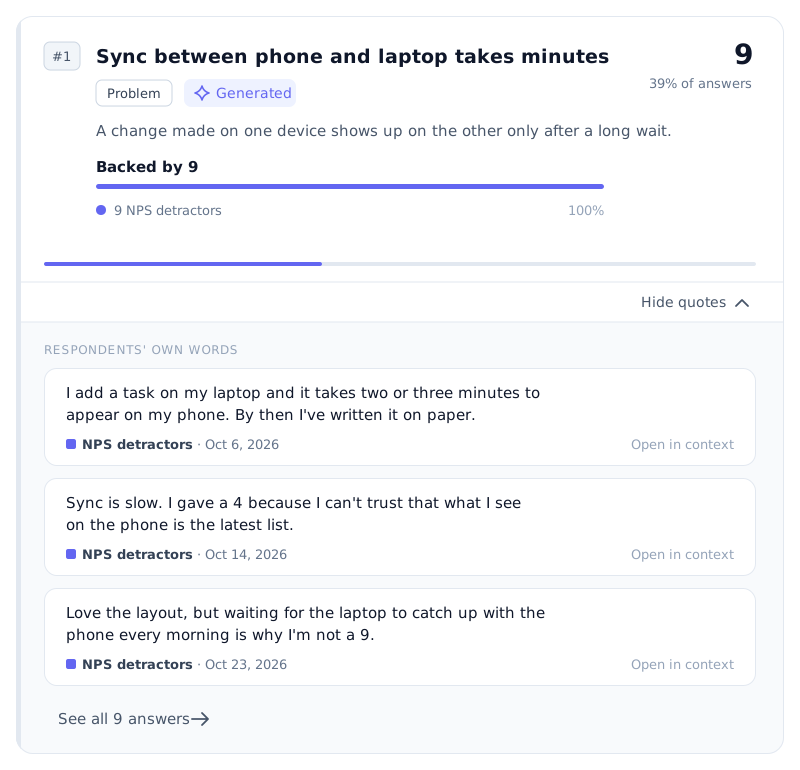
Illustration with example data.
Step 4 is built in. When a group falls under ten complete responses in the month you are looking at, RawQuotes names no insight in that project. It shows how many responses there are, how many more it needs and a link to read the responses, so the small group still gets read.
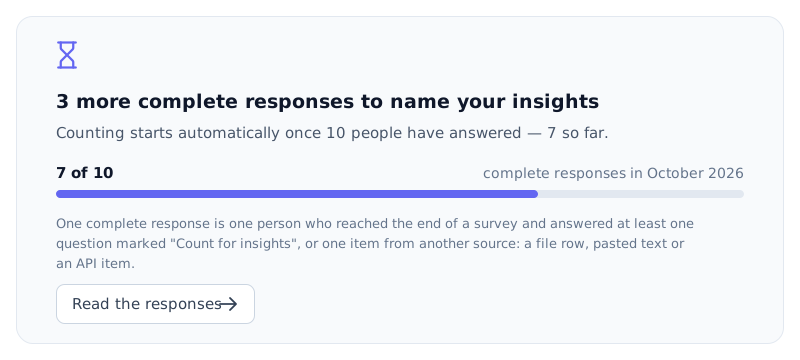
Illustration with example data.
If you run the survey itself in RawQuotes, the Recommendation score template asks the 0 to 10 question and shows its follow-up, "What would have to change for that to be a ten?", only to people who scored 0 to 6. The comments it collects are detractor comments to begin with; promoters and passives answer the score alone.
Where this method stops
The three bands are a convention. A 6 and a 0 land in the same group, though the person who gave a 6 may be one fix away from a 9. When a detractor reason looks big, check how many of its comments came from 5s and 6s.
Separate groups also mean separate names. RawQuotes may call the same complaint one thing among detractors and something else among passives, and it won't match them across projects. Compare the two lists yourself, and read the comments behind both insights before you say both groups mention it.
And the comments come from people who chose to write one. They tell you why those people scored as they did, not why everyone did. With small groups, three months of comments read in full can teach you more than one month split three ways.
To try this on your own NPS export, see the plans.